
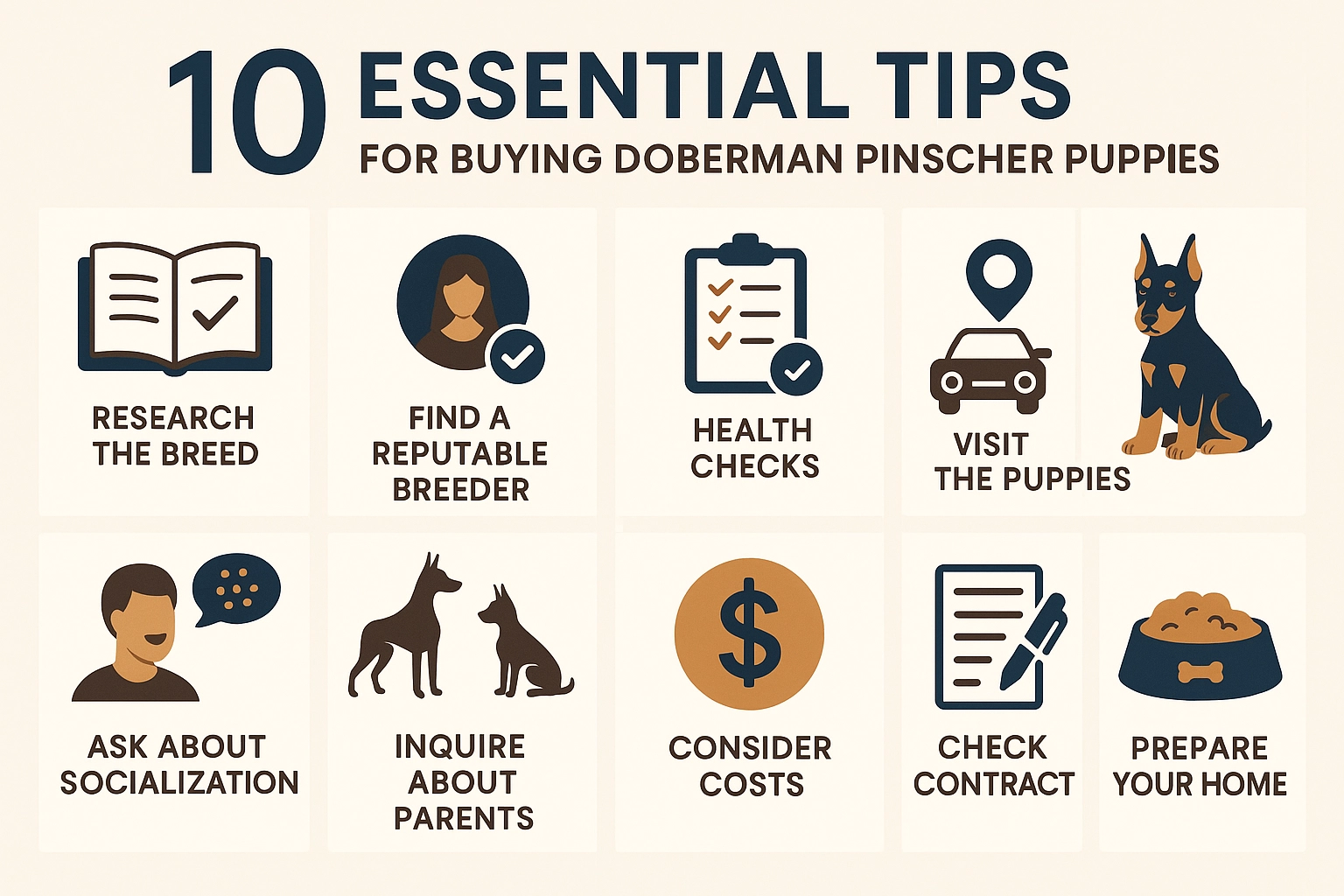
That sleek silhouette, the keen eyes, the “stick-to-your-side” loyalty—no wonder you’re smitten with Dobermans. But before you buy doberman pinscher puppies, let’s make sure your heart and home are truly ready for this brilliant, high-energy breed. Whether you’re brand-new to dog ownership or just new to Dobermans, this beginner-friendly guide will walk you through the essentials so you can choose confidently and avoid common pitfalls.
In the next few minutes, you’ll learn exactly what to look for in a reputable breeder (and the red flags to run from), the basic health checks that matter, how to match a puppy’s temperament to your lifestyle, and the real costs beyond the purchase price. We’ll also cover smart questions to ask, what to expect on pickup day, and how to set up your space so your new pup settles in smoothly. This listicle breaks everything into simple, actionable steps—so when you finally meet “the one,” you’ll know it. Ready to find a healthy, well-bred Doberman puppy and start on the right paw? Let’s dive in.
1. Importance of Choosing a Reputable Breeder
1) Seek breeders who conduct comprehensive health testing
When you buy Doberman Pinscher puppies, health testing isn’t a “nice to have”—it’s essential. Ask for proof of recent cardiac screening on both parents: a board-certified echocardiogram plus a 24-hour Holter within the last 12 months to reduce risk of DCM. Verify a DNA test for von Willebrand disease (vWD), OFA results for hips and thyroid, and a current CAER eye exam; reputable breeders will share certificates, OFA links, and registration numbers so you can confirm results. Many responsible breeders also belong to the Doberman Pinscher Club of America and emphasize documented testing across generations. Bonus: A solid contract should include a health guarantee and lifetime return-to-breeder support.
2) Consider breeders participating in AKC events for assurance
Breeders who compete in AKC conformation, obedience, rally, or agility are actively proving structure, nerve, and trainability—qualities you’ll appreciate in daily life. Look for titles like CH/GCH (conformation), CGC (temperament/citizenship), CD/CDX (obedience), or RN/RA (rally), and ask how the parents earned them. You can explore verified breeders and see evidence of involvement via the AKC Marketplace listing for Doberman Pinscher puppies. It’s also smart to attend a local show or training event and watch the breeder’s dogs work in a busy environment. This kind of transparency signals a serious, ethical program—not a quick, volume-based operation.
3) Verify longevity and temperament focus in breeding
Longevity matters in a breed predisposed to cardiac issues, so ask for ages and causes of death in the parents and grandparents, plus how the breeder tracks and screens for DCM over time. Temperament is just as critical for a family companion: meet the dam, note recovery after startle, and ask whether the breeder uses puppy aptitude testing and early socialization (ENS/ESI). Because Dobermans are intelligent, high-energy, and high-maintenance, early obedience guidance from the breeder is a big plus. Expect transparent programs to charge $1,000–$3,500+ in 2025 (the U.S. average is about $1,991), with European show/performance lines commanding higher prices amid strong demand; adoption typically runs $250–$800. Weigh what’s included—health testing, guarantees, microchip, and training support—so you’re paying for quality, not just a pedigree. With these checks, you’ll compare options confidently and invest in a healthy, stable partner.
2. Understanding the Costs Involved
- Average price to expect When you buy Doberman Pinscher puppies, plan for an average purchase price of about $1,991 in the U.S., with typical breeder costs ranging from $1,000 to $3,500+ in 2025. That “+” matters—high-demand litters and certain bloodlines push prices higher, as outlined in this helpful 2025 Doberman Pinscher price guide. Beyond the sticker price, budget an extra $600–$1,200 for first-year essentials like a crate, quality food, vaccinations, and beginner obedience classes. Because Dobermans are intelligent and high-energy, early training isn’t optional; plan for a puppy class within the first 3 months. Action step: ask breeders what’s included (microchip, first shots, ear cropping, limited AKC registration) so you can compare apples to apples.
- Why breeding quality and pedigree change the price Breeders price pups based on pedigree, health screening depth, and whether the dog is “pet quality” or a show/working prospect. Puppies from lines with titles (conformation, IPO/IGP, agility) and comprehensive cardiac/hip/thyroid testing often cost more and can exceed $3,500. European-line Dobermans, popular for show and performance, usually carry a premium due to demand and import costs. Expect higher prices for full breeding rights, cropped/docked packages, and for breeders affiliated with strong networks (e.g., regional clubs) who invest in careful socialization. Action step: ask for proof of parental health clearances and clarify if your contract is limited registration (pet) or full (breeding/show) to understand the price difference.
- Adoption as a budget-friendly path If you’re cost-conscious, adopting can run $250–$800 (many rescues list $300–$800), usually including spay/neuter, vaccines, and a microchip. You’ll most often find adolescents or adults, though puppies do pop up—just expect a waitlist. Adoption fees are rising in 2025, but they’re still far below breeder prices, freeing funds for training, insurance, and a quality diet. Look for Doberman-specific rescues in your region and complete applications early; home checks and references are common. Action step: set alerts with shelters and rescues and be ready to move quickly when a good match appears—good fits get adopted fast.
With a clear view of costs, you’ll be ready to compare sources and plan your purchase timeline confidently.
3. Preparing Your Home with Essential Supplies
Getting your space ready
- Stock the essentials for day one
You’ve likely budgeted $1,991 on average to buy Doberman Pinscher puppies (with breeder prices ranging from $1,000–$3,500+ and adoptions at $250–$800), so line up supplies before pickup to avoid costly “panic” runs. Start with a sturdy wire crate (42–48 inches for most Dobes; size up for larger European lines) and a foldable exercise pen for safe confinement. Add two stainless-steel bowls, a flat collar with ID tag, a 6-foot leash, and a high-quality large-breed puppy food; split meals into 3 feedings to support steady growth. Include soft, pea-sized training treats, washable bedding, and durable chews (e.g., KONG, rubber tug, nylon bones)—skip rawhide to avoid digestive risks. Finish with an enzyme cleaner for accidents, poop bags, and baby gates to block off no-go rooms. - Helpful add-ons that pay off
A short-coat grooming toolkit keeps maintenance easy: a rubber curry brush, grooming wipes, ear-cleaning solution, and a nail grinder you’ll use every 2–3 weeks. Dental care matters—grab a canine toothbrush and enzymatic toothpaste to start good habits early. A 15–30 ft long line, treat pouch, and clicker make training smoother; a snuffle mat or slow-feeder bowl provides mental enrichment and helps fast eaters. Consider a crash-tested car harness for safe transport and a basic canine first-aid kit. With 2025 costs trending up and high demand for robust European Dobermans, investing in tougher toys and an XXL crate can save replacements later. - Map your puppy’s living layout
Create three zones: a quiet sleep area with the crate (away from foot traffic), a play/training area with the pen and toy basket, and a potty path with a clear route to the door. Puppy-proof cords, remove toxic plants, secure trash, and keep shoes and remotes out of reach. Place a mat by the exit, hang the leash there, and set a “training station” with treats and a clicker to reinforce quick outs. Limit free-roam at first and gradually unlock spaces as manners solidify. After vaccines, enroll in a puppy class—see DPCA’s beginner guidance—to sync your home setup with consistent early obedience.
4. Training and Socializing Your Doberman Puppy
- Start early—literally on day one. Doberman puppies are bright, driven, and high-energy, so short, fun “micro-sessions” (3–5 minutes, 5–8 times daily) work best to teach name recognition, crate comfort, potty cues, sit, down, and a rock-solid recall. Add impulse-control games like “wait” for food and doors to curb overarousal before it starts. Budget-wise, early training protects your investment—whether you spent about $1,991 on average (often $1,000–$3,500+ from breeders) or adopted for $250–$800—and costs are rising in 2025 per 2025 Doberman Pinscher cost trends. Aim for 60–90 minutes total daily enrichment (split between brisk walks, puzzle feeders, and training games) to channel that brain and body productively.
- Socialization keeps protective instincts appropriate. During the prime window (8–16 weeks), follow a simple “3-3-1” plan each week: meet three new people (varied ages, hats, uniforms), explore three new environments or surfaces (metal grates, elevators, busy sidewalks), and greet one friendly, vaccinated dog in a controlled setting. Pair every new sight or sound with treats so your pup learns “novel = good,” and practice “look at that” games to build calm focus. Skip chaotic dog parks; opt for vet-run puppy socials and short visits to hardware stores, outdoor cafes, and parking lots. European-line Dobermans can have strong drive (a reason they’re popular in show and performance), so keep exposures brief, end on success, and reward neutrality as much as friendliness.
- Consistency and positive reinforcement make training stick. Use one cue per behavior, a clear marker word (“Yes!”), and high-value rewards; then fade to variable reinforcement once your puppy is reliable. Avoid harsh corrections—these can increase anxiety and distrust in a naturally protective breed—instead, redirect and reward desired choices. Build a routine: morning sniff-walk, midday puzzle, evening training, plus a few 3–5 minute impulse-control drills. Consider a puppy class (often $150–$300) with a CPDT-KA or KPA-certified trainer; many DPCA-aligned breeders encourage structured training from the start. For safety and reliability, practice recall on a 15–30 ft long line and keep a simple training log to track progress and setbacks.
5. Health Concerns and Genetic Conditions
1) Understand increasing risks of Dilated Cardiomyopathy (DCM)
DCM is the headline health concern in Dobermans, and it can be “silent” for years before sudden symptoms appear. Studies have shown Dobermans have one of the highest breed risks—some lines face an estimated lifetime risk approaching 40–50%, with typical onset in mid-adulthood. Early signs can be subtle (reduced stamina, fainting, coughing, fast resting breaths), so proactive screening matters. Plan a baseline 24-hour Holter monitor and echocardiogram around 12–18 months, then annually; many owners add a blood test for cardiac biomarkers (like NT-proBNP or troponin). This diligence isn’t just about health—it’s financial planning too. Catching DCM early can reduce emergency costs and help you budget wisely when you buy Doberman Pinscher puppies.
2) Use health testing to reduce risk—not eliminate it
Health testing doesn’t guarantee a DCM-free life, but it stacks the odds in your favor. Ask breeders (ideally DPCA-affiliated) for proof that both parents had a board-certified cardiologist echo and 24-hour Holter within the last 12 months, plus thyroid and eye clearances. Some breeders also disclose DNA results for known risk variants (e.g., PDK4, TTN), which are informative but not definitive. Verify clearances via public databases and follow OFA cardiac screening recommendations. Expect top-tier testing to be reflected in price—often toward the $1,000–$3,500+ breeder range (2025), compared with $1,991 average—but it’s a rational premium for transparency and reduced unknowns.
3) Stay current on studies and trends
Science evolves, so your plan should too. Keep an eye on ongoing research about diet-associated DCM; while the FDA hasn’t issued final conclusions, many cardiologists advise choosing established, WSAVA-aligned pet food brands and avoiding fad or exotic-ingredient diets. Track breed-health updates through the Doberman Pinscher Club of America, OFA, and veterinary cardiology groups, and keep copies of each year’s Holter/echo in one place. Also note market trends: costs for both adopting ($250–$800) and buying ($1,000–$3,500+) are rising in 2025, and demand for European lines is high—neither guarantees better hearts. Whatever path you choose, pair a solid health-tested start with consistent annual screening and training to support a long, active life.
6. Ethical Considerations When Buying a Doberman
1) Choose welfare-first, standards-driven breeders
Ethical breeders put the dogs ahead of deposits. They raise litters in-home, limit breedings, and prioritize sound temperament, early socialization, and a return-to-breeder clause. When you buy Doberman Pinscher puppies from a welfare‑first program, expect transparent contracts, proof of vet care, and thoughtful placements—not same‑day sales. Pricing reflects this rigor; with 2025 demand—especially for European show/performance lines—rising, expect purposeful litters in the $1,000–$3,500+ range. Beware red flags: multiple litters available year-round, “European bloodline” used as hype without health proofs, or no questions for you. A welfare-first breeder will interview you as carefully as you interview them.
2) Back breeders who invest in health initiatives
Beyond individual health testing, look for breeders engaged in breed-wide improvement. Ask whether they health test with cardiologist-performed echocardiograms and 24‑hour Holter monitoring, submit results to public registries (e.g., OFA/CHIC), and follow the Doberman Pinscher Club of America Code of Ethics. Many also run or sponsor local echo clinics, share longitudinal data on Dilated Cardiomyopathy, and collaborate with researchers. Supporting these programs with your purchase dollars (the U.S. average purebred price sits around $1,991) helps reduce hereditary risk for future litters. Request evidence: recent test dates, registration numbers, clinic flyers, and sample reports with identifying information redacted.
3) Explore adoption as a responsible alternative
Adoption reduces demand for careless breeding and can be budget-friendlier, typically $250–$800, with many rescues including spay/neuter, microchip, vaccinations, and behavior assessments. Reputable Doberman rescues screen homes, offer support, and use foster notes to match energy levels—smart for a high‑maintenance, high‑drive breed needing consistent training. Actionable steps: apply early, ask for candid behavior and medical histories, and set aside funds for obedience classes and insurance. If you want competition prospects or specific pedigrees, a breeder route may fit; for companions, adoption often delivers real‑world temperament data. Consider foster‑to‑adopt to ensure your routine, housing, and training bandwidth align with the dog’s needs. Either path, choose organizations that prioritize welfare, transparency, and lifetime safety nets.
Conclusion: Making an Informed Decision
- Buy or adopt with eyes open
When you buy Doberman Pinscher puppies, know the numbers and what they mean. In 2025, breeder prices typically run $1,000–$3,500+ (with a U.S. average around $1,991), while adoption usually costs $250–$800—both trending upward. Costs also vary by purpose and lineage: European lines and show prospects command premiums over American-line pets. Prioritize breeders who belong to the Doberman Pinscher Club of America and can show current cardiac (echo/Holter), thyroid, and hip results for both parents. If a seller can’t provide documentation or pushes quick deposits, walk away. - Use a research checklist before you pay
Create a shortlist of three reputable sources (breeders or rescues), then compare contracts, health guarantees, and lifetime support. Ask to meet at least one parent, observe temperament, and see where puppies are raised. Verify test results through registries, request a sample contract, and ask about puppy return policies and waitlists. Red flags include pay-in-full before meeting the litter, no screening questions for you, and zero socialization plan. If adopting, ask about behavior assessments and foster notes. - Plan for the long haul
Dobermans are intelligent, high-drive, and high-maintenance in training needs. Budget $100–$250/month for food, training classes, and insurance, plus annual cardiac screenings and an emergency fund. Commit to 60–90 minutes of daily exercise and 10–15 minutes of training, nail care every 1–2 weeks, and regular dental hygiene. Schedule puppy kindergarten early and map a socialization calendar. Thoughtful planning now makes a confident, healthy partner for the next decade.