
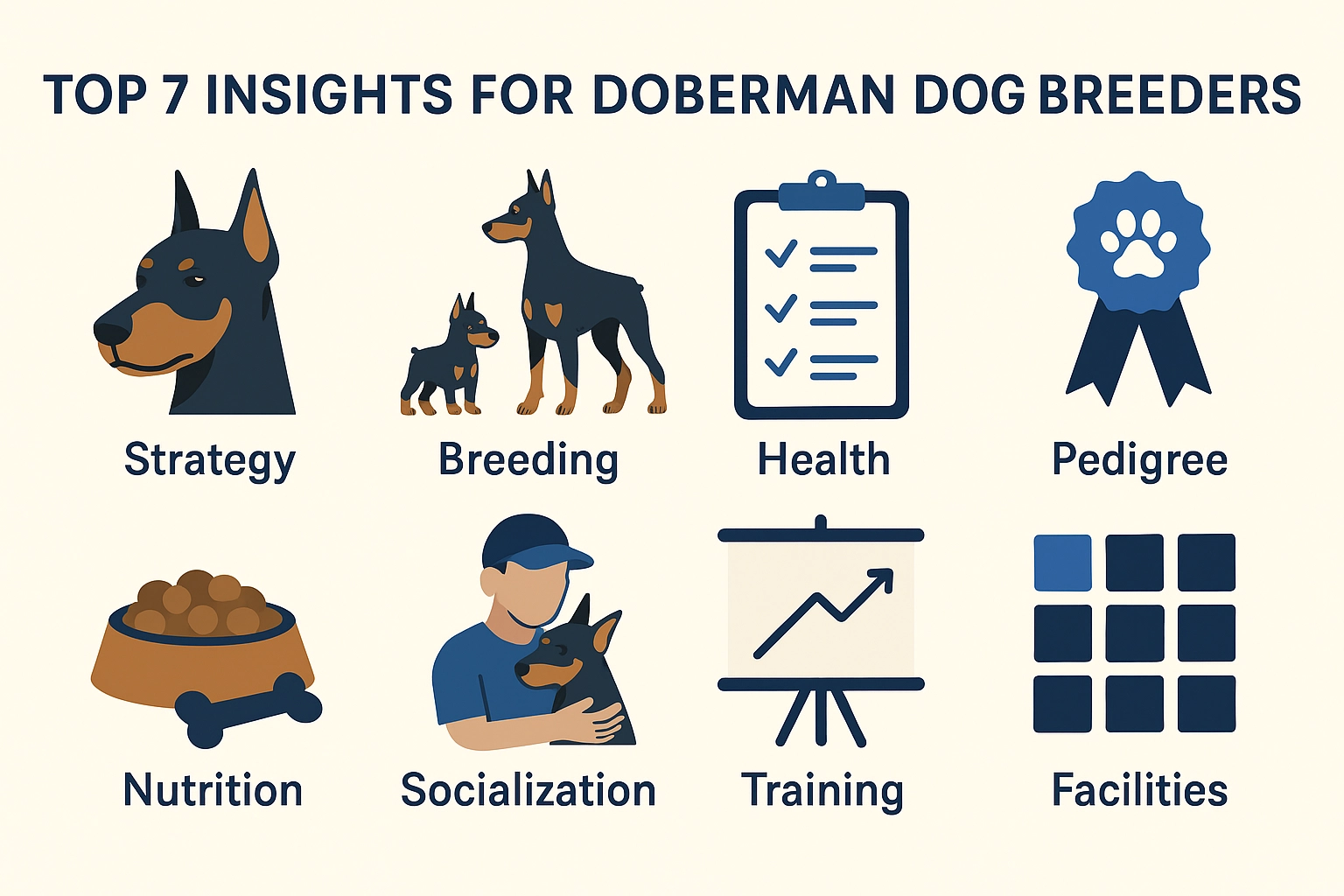
Breeding Dobermans isn’t about producing puppies—it’s about safeguarding a working legacy. If you’re a doberman dog breeder ready to refine an already solid program, this guide distills the seven insights that separate competent kennels from truly reputable ones.
You’ll learn how to tighten your selection criteria with health testing that actually predicts outcomes (think DCM Holter/echo strategy, vWD, thyroid, hips/elbows), how to balance drive and stability without dulling the breed’s hallmark courage, and how to condition breeding dogs for fertility and resilience. We’ll walk through risk-managed whelping protocols, neonatal benchmarks that flag problems early, and socialization windows that build confident, biddable temperaments. You’ll also get practical frameworks for contracts, placement, and client education that reduce returns and enhance long-term outcomes.
Expect actionable standards, not vague platitudes: checklists, metrics, and timelines you can apply in your next cycle. Whether you manage a single breeding pair or a small program, these seven insights will help you protect genetic integrity, optimize development, and place dogs that excel in both work and home. Let’s elevate your breeding decisions—one evidence-based step at a time.
Understanding Doberman Breeding Challenges
1. Inbreeding magnifies hidden health burdens
The Doberman’s AKC-recognized profile—sleek, powerful, and highly intelligent—was forged by intense selection, but a narrow founder base and popular-sire overuse have elevated inbreeding. Even with 659,257 Dobermans registered between 1980–2001, many pedigrees funnel back to a limited set of sires, concentrating risk alleles. Higher inbreeding increases expression of recessives (e.g., bleeding disorders) and compounds complex diseases, including heart and joint issues; diet can support these systems, but it cannot fix poor genetics. Actionable steps: calculate pedigree COI across 8–10 generations, avoid close-relative matings, and limit any single stud’s contribution across litters and regions. Finally, reject “merle Dobermans”—the pattern stems from unethical outcrossing, not breed type—because it introduces unknown health liabilities and confuses breeding decisions.
2. Prioritize measurable genetic diversity
Genetic diversity isn’t guesswork: UC Davis offers diversity testing that helps doberman dog breeders quantify heterozygosity and choose mates that reduce kinship while preserving type and drive. Use marker data to plan pairings over multiple generations, track diversity trends in your kennel, and bank semen from underrepresented lines. Combine this with performance/temperament evaluations so selection pressure doesn’t fall solely on the show ring. Breeders are increasingly adopting such tools, aligning with a long-term goal of healthier, longer-lived dogs. Build a written longevity plan—select for normal cardiac screens, multi-generational lifespan, and modest size—an emphasis enthusiasts report is still underused by show-focused programs.
3. Manage extinction risk through coordinated ethics
Without coordinated action, Dobermans face “functional extinction”: a population that exists but cannot thrive due to shrinking effective size and disease load. Counter this by refusing off-standard novelty (e.g., merle), curbing popular-sire cascades, and channeling buyers to vetted programs via the Doberman Pinscher Club of America breeder referral list. Educate owners that while adopting can cost $300–$400, responsibly bred puppies reflect health testing and diversity investments that safeguard the breed. Support lifelong health with high-quality, animal-based protein diets for heart and joint resilience, training, and structured conditioning—then document outcomes to guide future matings. In the next section, we’ll detail how to audit a breeder’s program step by step.
The Importance of Genetic Diversity Testing
Methods for assessing genetic diversity
As a Doberman dog breeder, start with DNA-based diversity mapping rather than guesswork. The UC Davis STR/DLA panel provides autosomal heterozygosity, internal relatedness (IR), and class I/II DLA haplotypes, letting you quantify how closely related a pair really is and whether a mating will increase homozygosity in key immune regions. Enroll your breeding stock and prospective outcrosses in the Genetic Diversity Testing for Doberman Pinschers program, then combine results with a 10+ generation pedigree-based COI to capture both genomic and lineage perspectives. Use mate-matching to prioritize complementary DLA haplotypes and a projected litter IR lower than the dam’s IR. Cross-check color genetics to avoid merle—its presence in Dobermans typically indicates unethical outcrossing and does not equate to responsible diversity. Maintain a kennel dashboard tracking heterozygosity, DLA haplotype counts, and COI so each pairing is data-driven.
Benefits of genetic diversity testing for breeders
Testing delivers immediate, compounding gains: lower average homozygosity can reduce the expression of recessive conditions and improve immune robustness, without sacrificing the sleek, powerful, intelligent type valued by the AKC. Despite 659,257 Dobermans registered from 1980–2001, effective population size is constrained by popular-sire dynamics; diversity data helps you avoid overused lines by selecting genetically distinct mates. Publish summary metrics (IR, COI, DLA haplotypes) in litter announcements—transparency differentiates your program and justifies pricing versus the $300–$400 typical adoption cost. Set usage caps (e.g., no single sire >5% of your kennel’s annual puppies) and rotate in underrepresented haplotypes to stabilize your gene pool. Finally, testing costs are modest relative to lifetime veterinary expenses, making it a high-ROI investment in health and reputation.
Role of genetic diversity in breed longevity
Longevity improves when breeders pair dogs to reduce inbreeding load across generations; this aligns with the growing emphasis on breeding for lifespan, even if not consistently practiced in the show circuit. Treat diversity as a core KPI: target matings that lower projected litter IR year over year and monitor age-at-death and cause-of-death records alongside titles. Reinforce genetic strategy with husbandry that supports heart and joint health—high-quality, animal-based protein diets are recommended for Dobermans and complement a long-life breeding plan. Avoid shortcuts such as merle outcrosses; genuine diversity is achieved by broadening within-breed genetic options, not by introducing incompatible alleles. Over three to five generations, disciplined mate selection, measured by improving diversity metrics and stable phenotype, is the most reliable path to a longer-lived, functional Doberman population.
The Doberman Diversity Project
1. Objectives of the project
The DDP aggregates genomic, pedigree, and health data to expand the Doberman’s effective population without losing AKC-recognized type. Using UC Davis STR/DLA panels and genome-wide heterozygosity, it maps lines, flags bottlenecks, and models pairings that raise diversity. It links genotypes to Holter and echocardiogram results to curb DCM and von Willebrand disease. Education confronts merle Dobermans—usually from unethical outcrosses—and re-centers longevity, often neglected by show selection. With 659,257 AKC registrations (1980–2001), DDP’s mandate is turning volume into resilient, long-lived dogs.
2. How joining benefits breeders
Joining delivers kennel-specific diversity reports, mate suggestions that lower COI and raise heterozygosity, plus population benchmarks. Action steps: upload pedigrees, run DNA panels, and get alerts when a planned mating concentrates rare risk haplotypes. Health modules track diet and cardiac testing; evidence favors animal-based protein for joint and heart support. Best practices include zero tolerance for merle matings and routine lifespan tracking across litters. Review transparent European-line disclosures at reputable programs such as Paul Doberman Kennel: European Doberman Puppies For Sale.
3. Project’s contribution to the broader canine community
DDP’s de-identified datasets accelerate research on DCM, autoimmune disease, and cancer, and its tools translate to other working breeds. Shelters benefit as healthier, behaviorally stable dogs are less likely to be surrendered, keeping adoption fees near $300–$400. Breed clubs gain diversity dashboards to modernize ethics codes and continuing education. The project’s anti-merle stance reduces misleading marketing and unethical outcrossing. Above all, it normalizes diversity testing as a standard, aligning responsible Doberman dog breeders with evidence-based care.
Ethical Breeding: Avoiding the Merle Doberman Trend
- Health risks associated with “merle Dobermans” Merle is not a recognized color in the Doberman Pinscher and typically appears only after unethical outcrossing. The merle allele (PMEL) is linked to auditory and ocular defects; double-merle breedings markedly elevate risks of deafness, microphthalmia, and other eye malformations documented across multiple breeds. These welfare liabilities stack on top of Doberman-specific concerns like dilated cardiomyopathy (DCM), creating unacceptable, avoidable risk. Litters marketed as “rare merle Dobermans” often produce puppies that require costly lifelong management or end up in rescue. Action points: DNA-test any suspicious coloration using the UC Davis VGL merle (PMEL) test, require BAER hearing and board-certified ophthalmic exams for at-risk dogs, and place all merle or merle-carrier dogs on non-breeding contracts.
- Evolving standards in ethical breeding practices Ethical standards are shifting away from color fads toward health, function, and longevity in line with the AKC-described Doberman profile—sleek, powerful, and intelligent. Breed discussions increasingly emphasize breeding for lifespan, even while some show programs lag behind, and the availability of UC Davis genetic diversity testing helps guide pairings that increase heterozygosity over time. With 659,257 Dobermans registered from 1980–2001, trends—good or bad—can amplify quickly, so leadership from responsible kennels matters. Practical benchmarks include publishing Holter/echo results each breeding season, OFA hips/elbows/thyroid, and setting internal COI caps per pairing. Welfare standards extend to nutrition: breeding stock and puppies should receive high-quality, animal-based protein diets to support heart and joint health.
- Guidelines to avoid unethical practices Verify pedigrees and registration histories; “rare color” marketing, merle, or harlequin descriptors are red flags in a Doberman. Codify ethics: no color-breeding, no outcrossing for patterns, mandatory DNA diversity profiling and cardiac screening before any mating. Educate buyers—legitimate Dobermans are not “rare merle” collectibles, and families seeking companions can often adopt for $300–$400 instead of funding unethical programs. Vet stud inquiries the same way: decline any request to “create merles,” document it, notify your breed club or rescue partners, and redirect the party to reputable breeders or adoption options. These steps protect dogs, your kennel’s reputation, and the breed’s future.
Understanding Doberman Longevity and Costs
1. Life expectancy: what responsible breeding delivers
Most Dobermans live 10–12 years, but longevity hinges on heart health and selection priorities. Dilated cardiomyopathy (DCM) remains the primary limiter, so ask a doberman dog breeder for multigenerational ages at death plus recent Holter/echocardiogram results for breeding stock. Breeding for longevity is growing among purpose-bred kennels, though it is still inconsistently prioritized by show-focused programs. With 659,257 Dobermans registered between 1980–2001, the population is large, yet effective diversity is narrower; using UC Davis diversity testing helps pair mates to preserve heterozygosity, a long-term hedge against inherited disease. Avoid “merle” offerings entirely—merle in Dobermans signals unethical outcrossing, adds risk, and brings no lifespan upside. Practical target: annual cardiac screening beginning at 3–4 years, rising to every six months if any arrhythmia appears.
2. Cost considerations for adopters: plan the first 24 months
Expect adoption fees around $300–$400; good rescues often include vaccinations and spay/neuter. Budget immediately for premium, animal-based protein diets to support joints and the myocardium; consistent nutrition is a lower-cost lever than crisis care. Add a preventive line item for baseline cardiology (Holter + echocardiogram), orthopedic screening after heavy growth, parasite prevention, and foundational obedience classes. Pet insurance or a dedicated emergency fund mitigates the financial shock of acute bloat, trauma, or sudden-onset DCM. Ask for full records, microchip transfer, and any DNA diversity data if the dog originated from a program using UC Davis panels.
3. Balancing care costs with breed benefits
The Doberman’s AKC-noted intelligence and athleticism return value when you invest early in training, enrichment, and conditioning—reducing injury, reactivity, and property damage. Preventive cardiology plus high-quality nutrition typically costs far less than late-stage interventions. Ethically sourced dogs (no merle, transparent pedigrees, diversity-aware pairings) also retain better insurability and predictability. Net effect: a sound, versatile partner for sports, security, and family life over a decade or more.
Actionable Steps for Responsible Breeding
1. Codify a health-first breeding protocol
Start by formalizing a written plan that puts function and lifespan ahead of ribbons. Breed only adults with current cardiac screening (annual 24-hour Holter plus echocardiogram), clear/managed vWD status, OFA hips/elbows, and thyroid panels; delay first litters until at least 26–30 months so late-onset issues surface. Maintain breeding females at lean body condition on high-quality, animal-based protein to support joints and heart—critical in a breed prized for its sleek, powerful, and intelligent profile. Limit repeat matings and allow recovery intervals of one heat cycle minimum. Implement standardized puppy rearing (early neuro stimulation, soundness surfaces) and publish your health protocol for buyers and co-owners.
2. Turn genetic data into mating decisions
Use UC Davis STR/DLA diversity testing to quantify autosomal heterozygosity and immune-region (DLA) haplotypes, then select mates to increase offspring diversity rather than guessing. Track pedigree COI across 10 generations and aim for pairings at or below breed-average COI; target <6–8% when feasible without compromising type. Combine genomic data with phenotype by prioritizing pairs that raise heterozygosity while preserving gait, working temperament, and headpiece. Validate single-gene results (e.g., vWD) but treat complex disease risk (like DCM) as polygenic—spread risk by avoiding closely related pairings. Keep a kennel dashboard logging each dog’s diversity scores, COI, and health results to guide future matings.
3. Protect the gene pool with strict ethical guardrails
Adopt a zero-tolerance policy for merle—its presence in Dobermans typically signals unethical outcrossing; require color DNA when pedigrees are uncertain. Cap popular-sire influence: no stud should exceed 3–5% of your program’s puppies in a rolling five-year window. Remember how popularity can distort a breed—659,257 Dobermans were AKC-registered from 1980–2001, and overuse of a few sires magnifies hidden faults. Diversify by rotating regional studs and importing underused lines vetted by health and diversity data. Put these rules in contracts and mentor new breeders on the why, not just the what.
4. Build for sustainability and longevity
Make longevity a selection trait: prioritize lines with documented relatives living past 11 years and track median lifespan for every branch you use. Raise the generational interval (e.g., evaluate a dog’s first mature offspring before repeating a cross) so slow-burn issues surface. Participate in collaborative databases and projects to share health outcomes, and commit to lifetime return policies; budget a rehoming fund pegged to typical adoption costs ($300–$400) for safety net coverage. Align nutrition, conditioning, and cardiac monitoring for breeding stock year-round to support heart and joint resilience. Close the loop by publishing annual outcomes—diversity metrics, cardiac clearances, and age-at-death—to drive continuous improvement.
Conclusion: Ensuring a Healthy Future for Dobermans
- Doberman Pinschers are sleek, powerful, and intelligent; that brilliance must be matched by health-first choices. Make longevity a primary selection trait—still underweighted in many show programs—and treat cardiac resilience as non‑negotiable. Use genetic diversity testing (UC Davis) to widen the gene pool, set COI targets, and plan pairings. Adopt zero tolerance for merle—evidence of unethical outcrossing—and reinforce lifetime performance with animal-based protein for joints and heart.
- As a doberman dog breeder, adopt measurable rules: test every breeding dog for diversity, publish anonymized results, and drive COI below 12% in two generations. Retire repeat DCM producers, refuse merle-linked pedigrees, and disclose pedigrees and health dashboards to buyers. Allocate 2–5% of litter revenue to cardiac research and regional screening clinics. Send each puppy home with a protein-forward diet plan and a schedule for owner-reported health updates at 6, 12, and 24 months.
- Community makes progress scalable. Clubs and rescues can mine AKC records—659,257 Dobermans (1980–2001)—alongside modern genomics to guide matings. Host quarterly group test days and stud exchanges, and normalize open registries that reward transparency. Support adoption where fees run $300–$400, mentor owners on evidence‑based nutrition, and report unethical merle marketing.