
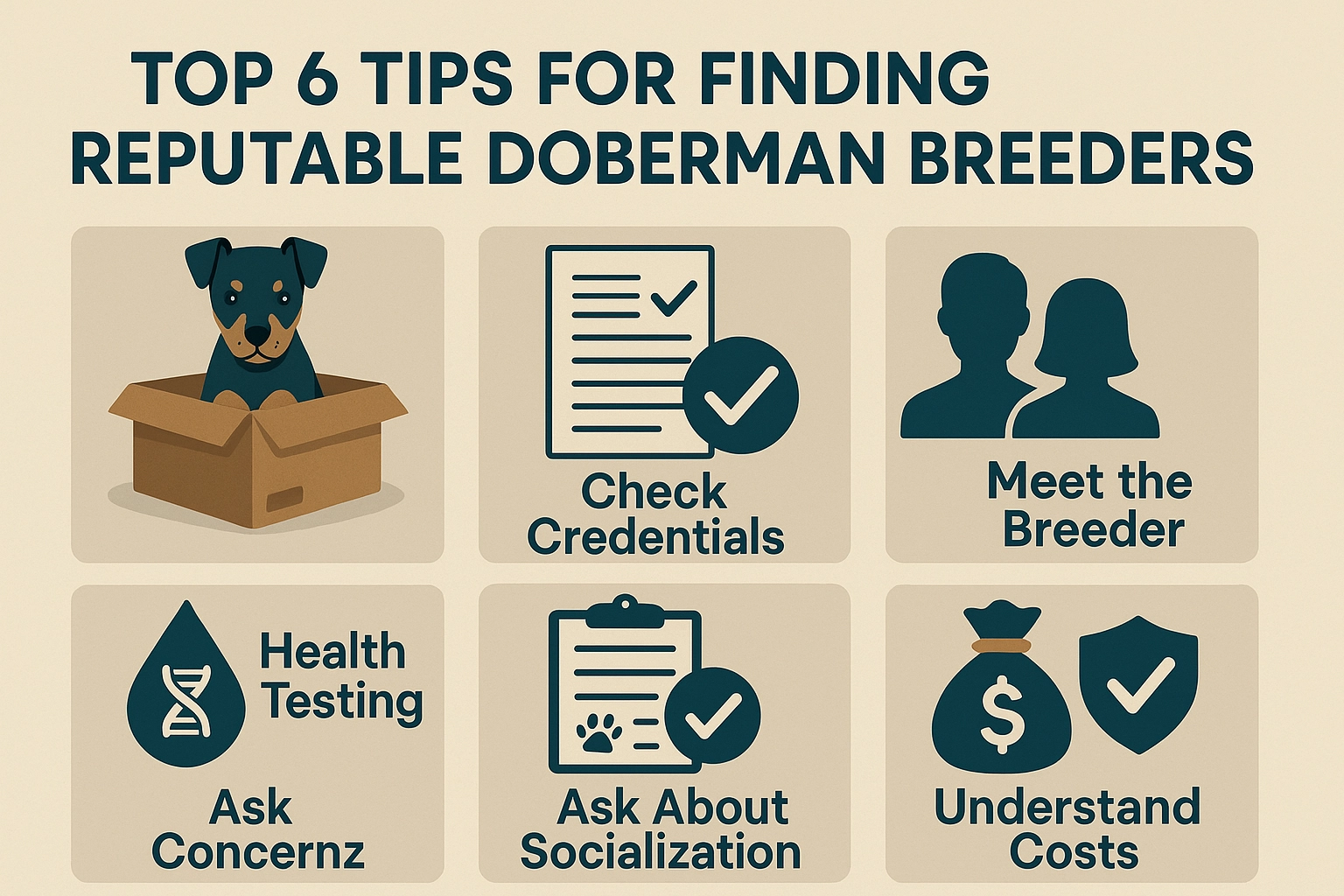
Ready to welcome a Doberman into your life? The breeder you choose will influence your dog’s health, temperament, and longevity for years to come. Yet a quick search for doberman puppies for sale breeders can feel like navigating a maze—slick websites, conflicting claims, and price tags that don’t always reflect quality. If you’re committed to finding a reputable source and avoiding costly mistakes, you’re in the right place.
In this guide, you’ll learn six proven, practical tips to identify ethical Doberman breeders with confidence. We’ll cover how to verify essential health testing, evaluate pedigrees and temperament, interpret contracts and guarantees, spot red flags and common scams, and ask the right questions on calls and visits. You’ll also discover where to find credible referrals, what a realistic waitlist looks like, and how to assess a breeder’s commitment to lifelong support. By the end, you’ll have a clear checklist to separate marketing from merit—and take the next step toward bringing home a sound, well-socialized Doberman from a breeder you can trust.
Researching Breeder Reputation
- Start by prioritizing breeders affiliated with the Doberman Pinscher Club of America (DPCA). DPCA members follow a Code of Ethics prioritizing health, temperament, and preservation, and many show or trial in AKC events. Ask a breeder for their DPCA membership number and verify it on the club’s roster; reputable programs are usually transparent about this. Request proof of participation in AKC shows or performance trials because it signals objective evaluation against the standard.
- Confirm membership in the United Doberman Club (UDC), particularly if you value working aptitude and balanced drive. UDC breeders emphasize IGP/IPO titles, BH temperament tests, and FCI-aligned structure, complementing AKC standards for a versatile Doberman. Ask for recent trial results or scorebooks and inquire how those evaluations inform their pairing decisions. Many UDC programs incorporate European bloodlines to preserve working ability while meeting show criteria, a growing trend among serious kennels. Membership, plus documented titles, indicates a program focused on more than just looks.
- Investigate a breeder’s track record using multiple sources before you short‑list doberman puppies for sale breeders. Review Google and Yelp comments, Facebook groups, and breed forums, and read three-star reviews for balanced insights. Cross-check kennel names and owner names, and ask for at least three references from owners with dogs over two years old. Given AKC’s 659,257 registrations (1980–2001), due diligence is essential. Compare offerings on AKC Doberman breeder listings in California and note programs that publish contracts, titles, and health documentation openly.
- Insist on verifiable health testing and keep copies of results, not just assurances. Minimums include annual echocardiogram and 24-hour Holter for DCM screening, vWD DNA status, OFA hips/elbows, thyroid panel, and CAER eye exams; many top kennels also list CHIC numbers. Ethical breeders explain how results affect mating choices and provide written health guarantees. Expect prices to reflect rigor—$1,000 to $3,500+ depending on reputation, pedigree, and testing across AKC/FCI-aligned lines. As you compare programs, prioritize those combining complete health data with temperament evaluations to build sound companions and competitors.
Evaluating Ethical Breeding Practices
1. Avoid breeders selling to pet stores or commercial breeders.
Ethical Doberman breeders place puppies only through direct, screened homes—not third-party retailers. Selling to pet stores or commercial brokers signals volume-driven practices that sidestep careful matching and lifetime support. Responsible kennels use written placement agreements, require spay/neuter for pet homes, and include a return-to-breeder clause. Even in high-demand regions like California, specialized programs rely on waitlists and interviews, not wholesale distribution. Given the breed’s long-standing popularity (AKC recorded 659,257 Doberman registrations from 1980–2001), ask explicitly whether any puppies are “brokered” or sold sight-unseen.
2. Ask about the breeder’s code of ethics.
Request a written code outlining breeding age limits, litter frequency, puppy socialization, and return policies. Reputable programs—often aligned with DPCA best practices—detail buyer screening, limited registration for pets, and transparent pricing. Expect clarity on costs (commonly $1,000–$3,500+, varying by pedigree, titles, and health assurances), deposit terms, and what’s included (microchip, initial vaccines, early training). When contacting doberman puppies for sale breeders, ask how they balance health, temperament, and conformation goals and whether they refuse homes that don’t fit the breed’s exercise and training needs. A thorough answer indicates a preservation-minded approach, not a transactional one.
3. Request documentation of health and temperament tests.
Insist on verifiable results for the sire and dam: cardiac echocardiogram by a board-certified cardiologist, 24-hour Holter monitor, OFA/FCI hips, thyroid panel, vWD DNA, and CAER eye exam. Ask for OFA or CHIC numbers you can confirm online. Temperament credentials may include the DPCA Working Aptitude Evaluation (WAE), BH/VT, or structured puppy testing with documented observations. Top programs increasingly publish results as buyer expectations rise, reflecting industry trends toward rigorous screening. Avoid breeders who claim “clear lines” without current, parent-specific documentation.
4. Inquire about breeder involvement in AKC or FCI events.
Active participation—AKC conformation, obedience, rally, and FCI/IDC working titles (e.g., BH, IGP, ZTP)—shows dogs are evaluated beyond the backyard. Many U.S. kennels emphasize European bloodlines to meet show and working standards under FCI. You can cross-check titles through AKC and club catalogs, and seek referrals in communities discussing responsible European show-line programs, such as this European show-line Doberman breeders discussion. Ask for registration numbers and catalog links for verification. These steps set you up for the next phase: comparing individual litters with confidence.
Understanding Health Testing Importance
1. Look for OFA/CERF certifications indicating health testing.
Responsible doberman puppies for sale breeders should provide verifiable Orthopedic Foundation for Animals (OFA) results for hips, elbows, thyroid, and cardiac, plus current eye clearances via CERF/CAER. Ask for the parents’ OFA profile links or CHIC numbers; for European imports, request equivalent FCI hip/elbow scores. Reputable kennels—often DPCA members active in AKC shows—publish results openly. In California and beyond, many European‑line programs highlight full panels; recent Yelp listings of top Doberman breeders in Los Angeles reflect this trend. If a breeder won’t share paperwork or says “the vet said they’re fine,” treat it as a red flag.
2. Ask about specific health issues common in Dobermans.
Prioritize discussion of dilated cardiomyopathy (DCM), von Willebrand disease (vWD), hypothyroidism, cervical spondylomyelopathy (Wobbler), hip/elbow dysplasia, and bloat. DNA tests should cover vWD and available DCM markers (DCM1/PDK4 and DCM2/TTN), with the caveat that DCM genetics are complex and not fully predictive. Insist on recent echocardiograms and 24‑hour Holter results for breeding dogs from a board‑certified cardiologist. Given historic popularity—AKC logged 659,257 Doberman registrations from 1980–2001—rigorous screening offsets quality gaps. Ask exactly when each test was performed and how results inform mating decisions.
3. Ensure puppies receive early health screenings.
Before placement, puppies should have a veterinary exam at 6–8 weeks, first DHPP vaccination, microchip, deworming, and a clean fecal test. Many top breeders add baseline cardiac auscultation and an ophthalmic check; some repeat exams before go‑home at 9–10 weeks. Request individual puppy records, vaccine schedules, and a signed health certificate. Programs focused on European working/show standards and AKC conformation typically pair health checks with early temperament testing. Verify that any abnormalities trigger deferral of placement or specialist referral.
4. Understand the financial implications of health problems.
Puppies from vetted lines commonly cost $1,000–$3,500+, reflecting testing, pedigree, and breeder reputation. By contrast, DCM diagnostics (echo $400–$800, Holter $200–$400) and lifelong meds can exceed thousands annually; emergency GDV surgery often runs $2,000–$6,000. Pet insurance averages $50–$100/month, but pre‑existing conditions may be excluded. Seek contracts offering 1–3‑year health guarantees and lifetime breeder support. Paying for proven health testing upfront is usually the least expensive path over a Doberman’s lifespan.
Navigating European vs. American Doberman Breeders
1. FCI vs. AKC: know the rulebook behind the dogs
European kennels breed to FCI standards (males 68–72 cm; females 63–68 cm), allow natural ears/tails, and prize working aptitude with substance. U.S. programs follow the AKC Doberman Pinscher breed standard, favoring elegance and 26–28 in males, 24–26 in females. Many doberman puppies for sale breeders in California now register AKC litters from FCI-imported parents, signaling dual focus. Action step: ask which standard guides selection for bone, head, and drive, and request size projections plus stacked photos. If you want IGP prospects, an FCI-leaning program may fit.
2. Pet quality vs. show quality: what matters for your household
Show prospects meet stricter cosmetic and temperament thresholds and may involve co-ownership; pets have minor, non-health faults but must still clear OFA cardiac/thyroid and DNA panels. Pricing reflects this: expect $1,000–$3,500+, with elite European pedigrees commanding more. Don’t assume “show” equals “better pet”—high-drive candidates can overwhelm casual homes, while a pet-quality American-bred puppy may be perfect. Action step: request 7–8 week structural evaluations, a written placement rationale, and clarity on limited registration, spay/neuter timing, and any performance rebates.
3. Gauge a breeder’s show influence, not just claims
Influential programs prove consistency with AKC CH/GCH, group placements, DPCA Top 20 invites, FCI/IDC ratings, and working titles (IGP, BH-VT). Verify wins on AKC event results and DPCA listings; top Yelp-reviewed kennels often mention complete health testing and active showing. Many California breeders with European sires campaign in both AKC and IGP—evidence they value type and function. Action step: examine three-generation pedigrees for multiple titled dogs, not a single outlier.
4. Regional temperament and size differences: fit to function
European lines typically carry heavier bone, darker pigment, and higher working drive; American lines are often slightly more refined with a smoother outline and balanced companion temperaments. Many U.S. kennels now blend European blood to meet demand for biddable yet capable dogs. Action step: meet or video-chat with both parents and adult siblings to gauge energy, nerve, and size. Given long-term popularity (AKC logged 659,257 registrations from 1980–2001), pick for lifestyle fit, not trends.
Exploring Puppy Costs and Contracts
1. Price range ($1,000–$3,500+)
Expect reputable doberman puppies for sale breeders to price litters between $1,000 and $3,500+, with higher figures tied to health testing, titled parents, and pedigrees. Geography influences cost—California and high-cost markets usually price above average—and European FCI lines or dual FCI/AKC registration can command premiums. Demand is steady (AKC logged 659,257 Doberman registrations from 1980–2001), so waitlists are common for well-bred pups. Be wary of bargain pricing, which often correlates with skipped screenings or poor socialization.
2. What’s included
Baseline inclusions typically cover age-appropriate vaccinations, deworming, a microchip, and a veterinarian health certificate. You should also receive limited AKC registration (or an FCI export pedigree), a care plan, and copies of parental results: OFA hips/elbows, cardiac evaluation—ideally echocardiogram for DCM—vWD DNA, thyroid, and CERF/CAER eyes. Tail docking/dewclaw removal is usually included; ear cropping is often optional and billed separately ($400–$800) with posting guidance. Expect extras like travel, flight nanny service, and sales tax to be itemized, while lifetime breeder support is a value add.
3. Breeding rights vs. pet-quality
Most families purchase pet-quality puppies on limited registration with a spay/neuter requirement after maturity (commonly 18–24 months). Full registration or breeding rights can add $1,000–$2,000, may involve co-ownership, and often require completing health tests or earning show/working titles. Contracts frequently include no-resale terms, right of first refusal, and return-to-breeder provisions to protect the dog. Ask for a sample contract before you place a deposit and confirm how any performance conditions affect ownership.
4. Health and temperament guarantees
Health guarantees should specify a 48–72 hour vet check window and a 1–3 year genetic warranty covering hips, eyes, thyroid, and inherited cardiac disease. Because DCM is complex and polygenic, many breeders require periodic cardiac screening to keep coverage valid, especially for European pairings. Clarify remedies—replacement puppy, partial refund, or medical reimbursement—and whether returning the dog is required. Temperament assurances often depend on documented socialization and training; look for DPCA-aligned policies, show participation, and verifiable health records to substantiate claims.
Conclusion: Making an Informed Decision
- Choose the right breeder to set the foundation. Reputable doberman puppies for sale breeders—often DPCA members—prioritize health, temperament, and correct type, with many in California and other regions aligning to both AKC and FCI standards. Top kennels health-test, title their dogs in AKC rings, and are transparent about European vs. American bloodlines and goals (show, work, or balanced). This diligence isn’t window dressing; it reflects a breeding program designed to minimize risk and maximize predictability. In a breed with a long history—AKC data recorded 659,257 registrations from 1980–2001—consistency matters.
- The payoff is long-term health and stable temperament. Ethical programs invest in comprehensive screenings and temperament assessments, supporting the current trend toward deeper health and behavior testing. Puppies from such lines typically show better nerve stability, clearer drives, and fewer costly surprises, which can reduce lifetime veterinary and training expenses. European-leaning programs that breed to FCI size and working aptitude often deliver the substance and clarity many families and sport homes seek.
- Be patient—quality takes time. Expect waitlists and price variability ($1,000–$3,500+), driven by pedigree, health guarantees, and breeder reputation. Skipping the queue for an impulse purchase often means compromising on health, socialization, or aftercare. A few extra months now can mean a decade of better outcomes.
- Start strong with a clear plan. Build a shortlist of 5–7 DPCA-affiliated kennels across regions, including California. Verify health results, review sample contracts, and request references from recent buyers. Compare litters by goals (show, working, companion), not just color or ear style. Schedule kennel visits or virtual tours, budget realistically, and document your findings to make a confident final choice.