
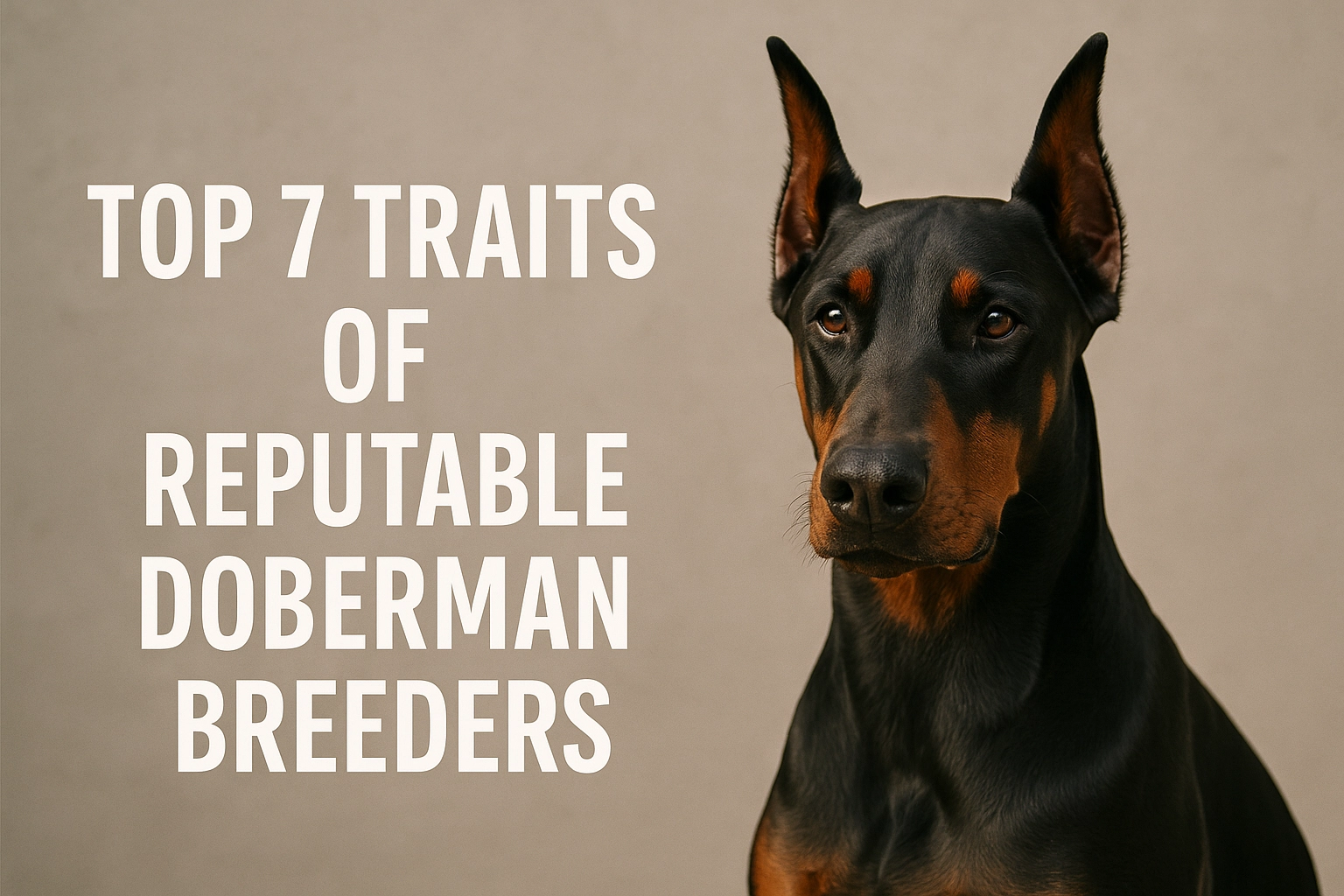
Choosing the right Doberman starts with choosing the right breeder. Bloodlines, health, and temperament are shaped long before a puppy comes home, so your success depends on knowing how to separate marketing gloss from genuine ethics and expertise. In this guide, we focus on reputable doberman breeders, the standard bearers who prioritize the breed’s welfare over quick sales and convenience.
You will learn the seven defining traits that consistently signal quality. We will cover health testing that actually protects future soundness, the kind of documented proof you should expect to see, and how to evaluate temperament and structure beyond pretty photos. You will understand what transparent communication looks like, why thorough placement screening is a positive sign, and how contracts, guarantees, and lifetime support work in practice. We will also touch on meaningful involvement in breed clubs and performance venues, and the red flags that reveal volume operations. By the end, you will be able to vet breeders with confidence, ask the right questions, and choose a partner who elevates both your experience and the breed itself.
Top Traits of Reputable Doberman Breeders
1. Rigorous cardiac and DNA health testing
Reputable Doberman breeders treat Dilated Cardiomyopathy as top priority. Require annual echocardiogram and 24 hour Holter by a cardiologist. DCM1/DCM2 DNA informs but never replaces clinical screening; see DCM testing overview. Ask for reports dated within 12 months, plus thyroid, hips, eyes.
2. Documented commitment to longevity
Longevity focused breeders carefully track ages across multiple generations. The DPCA program certifies Dobermans reaching 10 plus years; review the DPCA Longevity overview. Request percentages of close relatives that reached double digits. Get written causes of death for parents, grandparents, and siblings.
3. Ethical practices that protect breed integrity
Ethical programs breed sparingly and select for stable temperament. They disclose records, offer lifetime support, and multi year guarantees, for example six years. Use this club checklist for choosing a breeder during interviews. Confirm return clauses and early socialization commitments in the contract.
4. Thoughtful natural rearing and nutrition
Natural rearing is growing, including balanced raw feeding. Community discussions often draw 70 plus comments on protocols. If raw, request complete recipes, calcium phosphorus ratios, and oversight. If kibble, ask for transition plans and individualized, evidence based care.
5. Limited breeding for optimal care and outcomes
Limited programs produce few litters and give intensive handling. Expect plans around dam recovery and long term goals, not demand. Look for neurological stimulation, sound desensitization, and temperament testing. Ask litters per year, dam rest intervals, and daily caregiver names.
The Importance of Comprehensive Health Testing
1. Prioritize DCM screening at breeding age and beyond
Dilated Cardiomyopathy remains the leading health concern in the breed, with an estimated 58 percent of Dobermans developing DCM during their lifetime, which makes early and ongoing screening non negotiable for reputable Doberman breeders. Annual echocardiograms and 24 hour Holter monitoring help detect occult disease long before clinical signs appear, allowing responsible breeding decisions. Genetic risk is complex, but known variants still matter; research indicates elevated risk associated with PDK4 DCM1 and TTN DCM2 mutations, though not all carriers become affected and not all affected dogs carry these variants. Review breeder protocols that combine cardiologist led echo plus Holter with DNA screening, and confirm rechecks over time. For context on prevalence and genetics, see the 58 percent DCM overview, NC State interpretation of DCM1 and DCM2 results, and the AKC guidance on interpreting DCM risk.
2. Verify von Willebrand’s factor antigen and genotype results
Dobermans are predisposed to von Willebrand’s Disease Type I, which can complicate surgery and cause unexpected bleeding. Ask breeders for vWF antigen percentage, the DNA genotype for vWD, and a clear pairing plan that avoids producing affected puppies. Request documentation for both sire and dam, then confirm that puppies come with test results or parentage proof. Before spay or neuter, ensure your veterinarian repeats clotting assessments.
3. Require CHIC compliant, breed specific health checks
The CHIC framework aligns Doberman health testing to the breed’s risks, typically including hips, thyroid, cardiac evaluation by a cardiologist with Holter, and vWD. Ask for the dog’s CHIC number and the list of completed tests, dates, and interpretations. Responsible breeders maintain updates as dogs age, not one time clearances. Use those records to compare littermates and related dogs when evaluating longevity and soundness.
4. Demand complete, verifiable health certificates
Health certificates should bundle veterinary exam notes, vaccination and deworming logs, microchip ID, and primary health screening results. Ask for cardiology reports, Holter summaries, thyroid panels, and vWF documentation in one organized PDF before placing a deposit. Read lab reference ranges and cardiologist impressions, not just “normal” labels. Keep copies to guide your veterinarian’s baseline care and future screenings.
5. Look for a written, long term health guarantee
Draggin Dobermans in Houston backs its program with a 6 year health guarantee that covers major hereditary conditions such as DCM, vWD, and hips. A meaningful guarantee signals confidence in testing, selection, and natural rearing practices that support longevity and temperament. Review terms carefully, including owner responsibilities like routine cardiac screening and nutrition. Guarantees paired with transparent records make it easier to invest in the right puppy and breeder relationship.
Breeding for Longevity: A Key Focus
1. Track and reward proven longevity
The DPCA Longevity Program awards certificates to Dobermans reaching age 10 or greater, creating a clear benchmark for long-lived lines. Ask breeders to document LC and Bred for Longevity on pedigrees. Request three-generation age and cause-of-death data. Favor pairings from families with senior-age cardiac clearances and multiple long-lived relatives.
2. Prioritize health, not ribbons
Reputable Doberman breeders select for health first, not ribbons. Require lifetime cardiac surveillance across milestones, full DNA panels, and OFA-based orthopedic, thyroid, and eye evaluations before breeding. Ask for written objectives that target higher median lifespan. Retire breeding stock the moment age-linked disease appears, preventing propagation.
3. Use European bloodlines thoughtfully
European bloodlines often live longer due to working selection and broader genetic diversity. Verify claims by asking for coefficient of inbreeding, longevity of siblings, and the ages of grandparents, aunts, and uncles. Balance imports with domestic lines that document longevity. Let lifespan metrics outweigh fashion-driven type preferences.
4. Expect vitality and stable temperament as outcomes
Selecting for longevity improves vitality and temperament. Dogs from long-lived families show steadier energy, quicker recovery, and clearer nerve. The DPCA highlights balanced excellence across temperament, trainability, athleticism, and longevity in its Apex and Legacy Awards. Review objective temperament tests alongside health and performance records.
5. Pair genetics with lifestyle support
Lifestyle support turns good genetics into long life. Expect guidance on optimal body condition, progressive conditioning plans, and age-based cardiac checks at midlife and senior years. Many ethical programs offer long health guarantees, for example six-year coverage, plus lifetime breeder support. Ask for follow-up schedules and nutrition frameworks that you can implement.
Adherence to Ethical Breeding Practices
1. Align with DPCA and AKC ethical standards
Reputable Doberman breeders operate within clear, published frameworks that protect the breed and the buyer. The DPCA Code of Ethics calls for truthful representation, written sales agreements, proper care, and health testing of breeding stock. AKC guidance reinforces responsible recordkeeping, appropriate timing of breedings, and lifetime responsibility for dogs produced. Action step: ask the breeder to show how their contracts, placement policies, and health protocols map to these standards, and request sample documents in advance.
2. Transparent breeding philosophies shared with customers
Ethical programs explain not just what they do, but why they do it. Expect a clear rationale for pairings, proof of health testing, and visibility into puppy rearing and socialization. Draggin Dobermans & Great Danes in Houston publishes their priorities around temperament, longevity, and home-based social exposure, offering insight before you ever place a deposit. Action step: request copies of health results, a sample take-home schedule, and a walkthrough of the breeder’s early socialization plan.
3. Avoiding overbreeding supports ethical practices
Limiting litter frequency safeguards dam health and ensures adequate time for hands-on rearing. Responsible breeders space litters, retire dams at appropriate ages, and breed only animals that meet health and temperament benchmarks. Draggin maintains a limited program to keep quality ahead of quantity and to provide individualized care to every puppy. Action step: ask how many total litters a dam will have, how rest periods are managed, and how the breeder tracks maternal health over time.
4. Commitment to putting puppy welfare first
Ethics show up in daily decisions, from early neurological stimulation to careful temperament matching. Written return-to-breeder clauses, structured socialization, and lifetime support protect dogs for the long term, consistent with DPCA expectations of breeder responsibility. Buyers should see a clear plan for vetting homes and for ongoing guidance after pickup. Action step: confirm the return policy, post-placement support schedule, and the puppy’s socialization milestones before go-home day.
5. Draggin.net emphasizes ethical practices in Houston
In practice, Draggin pairs comprehensive health testing with natural rearing principles and a six-year health guarantee. Their home-raised puppies benefit from everyday sights and sounds, preparing them for confident transitions. Transparent communication, limited litters, and long-term owner support reflect a welfare-first philosophy. Action step: schedule a virtual or on-site visit and review the breeder’s checklist to see these ethical commitments in action.
Embracing Natural Rearing and Raw Feeding
Why many reputable Doberman breeders choose natural rearing
- Supports overall canine health and well-being.
Feeding a balanced raw, species-appropriate diet can improve digestion, coat quality, dental hygiene, and lean muscle in high-drive Dobermans. Many programs target about 70 to 80 percent muscle meat, 10 percent edible bone, and 10 percent organs, with roughly half of the organ portion as liver, then adjust for growth and activity. Puppies require precise calcium to phosphorus balance to protect joints and prevent orthopedic issues. For a balanced view, review the raw diet risks and considerations for Dobermans. - Aligns with growing breeder and owner interest.
Interest is rising among reputable Doberman breeders and owners who want diets that match canine biology. Online communities routinely generate 70 or more comments on natural-rearing threads, reflecting demand for practical how-to support and sourcing tips. When interviewing breeders, ask about raw protocols, sourcing, and how they transition puppies. Request written feeding plans and sample menus before pickup to confirm consistency. - Consultations offered for diet and care recommendations.
Expect structured consultations that cover portioning, safety, and growth targets. A common starting point is 2 to 3 percent of ideal adult weight per day for adults, adjusted for metabolism and exercise. Puppies often begin around 8 to 10 percent of current body weight, split into three to four meals, with scheduled reviews to verify body condition and mineral balance. Work with a veterinarian experienced in canine nutrition and book check-ins at 12 and 24 weeks. - Natural protocols reduce exposure to artificial substances.
Programs aim to limit synthetic inputs by favoring minimally processed foods, judicious vaccine schedules guided by titers, and integrated parasite management. Practice strict hygiene, freeze meats at minus 18 degrees Celsius, thaw under 4 degrees, and sanitize prep areas. Choose appropriately sized raw meaty bones, never cooked, to support dental health. Crate-feed bones and discard leftovers within 20 minutes to reduce contamination. - Ethical breeders like Draggin advocate for this method.
Houston-based Draggin integrates natural rearing within a limited program centered on temperament and longevity. Puppies leave with tailored guidance so families can maintain the regimen at home. A six year health guarantee signals commitment to measurable outcomes. This approach aligns with longevity goals, including benchmarks of 10 years or more, and reflects what discerning buyers expect from reputable Doberman breeders.
Choosing the Right Breeder for Your Doberman
- Meet with breeders to understand their programs. Schedule an in-person visit or video call to see how puppies are raised, including whelping areas, socialization plans, and early temperament exposure. Ask about litter frequency, selection criteria, and how sires and dams are proven through titles or structured evaluations. Ethical, limited programs often emphasize temperament and longevity, with puppies reared in the home for stable starts. Bring a checklist covering socialization protocols, placement criteria, and post-purchase support.
- Review health documentation and visit facilities. Request current cardiology reports, annual echocardiogram and 24-hour Holter, plus DNA results for vWD and DCM variants. Confirm orthopedic evaluations through OFA or equivalent, hip scores, and ask for thyroid and eye certifications. Verify dates, the specialist’s name, and that results are within the past 12 months. On site, assess cleanliness, ventilation, enrichment, and how the breeder manages quarantine, sanitation, and exercise.
- Compare breeder philosophies and breeding priorities. Clarify whether the program optimizes for conformation, working ability, family temperament, or a balance of all three. Ask how they track longevity across generations and how that data influences pairings. Discuss natural rearing protocols, nutrition plans, and how these are tailored for growth and heart health. Seek alignment with your goals, for example a confident family guardian with proven health depth.
- Draggin.net is open for consultation and questions. Based in Houston, this ethical program focuses on champion Dobermans and Great Danes, limited litters, and stable temperaments. Expect comprehensive health testing, natural rearing protocols, and a six-year health guarantee that reflects strong confidence in breeding decisions. Prospective owners can request sample contracts, health records, and guidance on fit and preparedness. Ongoing, lifetime support is central to the relationship.
- Consumer reviews and references add reliability. Request three to five recent buyer references, plus veterinary and trainer contacts. Verify consistent communication, health transparency, and support after pickup. Study public feedback for patterns rather than one-off comments, looking for updates on health testing and longevity. Red flags include pressure to commit quickly or reluctance to share verifiable documentation.
Conclusion
- Identify reputable Doberman breeders by demanding proof, not promises. Ask for cardiologist-issued echocardiogram and 24-hour Holter results dated within the last twelve months for both parents. Request DNA panels covering DCM1, DCM2, vWD, and color dilution; confirm OFA thyroid and hip scores, plus CHIC listing where applicable. Verify reports match microchip IDs.
- Make longevity a selection criterion. Prioritize families with multiple relatives reaching ten or more years and DPCA Longevity recognition. Study five-generation pedigrees for age-at-death data, not just titles. Discuss coefficient of inbreeding and participation in diversity projects, then choose pairings shown to improve health metrics across litters.
- Demand ethical, transparent process. Expect a detailed contract and multi-year health guarantee; six-year terms show rigor. Confirm limited breeding frequency per dam, structured socialization, and temperament evaluations using objective tools. Ask for nutrition protocols, including natural rearing or balanced raw frameworks, and insist on lifetime support with clear return-to-breeder clauses.
- Leverage expert guidance. Partner with Draggin Dobermans to align goals, whether seeking a performance prospect or a steady family companion. Expect transparent health dossiers, puppy matching, and mentoring on training, cardiac screening schedules, and diet. Comprehensive testing and a six-year guarantee reduce risk; use their experience to interpret reports and make confident choices.